
SAFE-T ACT
CTA arson attack suspect was on Illinois release status after 72 prior arrests
The suspect in the November 17 CTA Blue Line attack, in which a victim was doused with gasoline and set on fire, is a person who had previously been arrested on serious criminal charges and then released into what the court called “home confinement.” A pervasive pattern of home-confinement violations has been repeatedly observed in Chicago and Cook County. After being placed in “home confinement” suspect Lawrence Reed ignored the court advice, left his home, filled a container with gasoline, and climbed aboard a Blue Line electric train. A search of Reed’s criminal record showed that he had 72 prior arrests. The arson victim, Bethany MaGee, survived with critical injuries.
Current Illinois law, the so-called ‘SAFE-T Act,’ allows (and, in the views of many jurists and law enforcement officials, encourages) the courts to grant pre-trial release to persons awaiting trial on serious criminal charges. Illinois House Republicans unanimously oppose the SAFE-T Act and demand that Illinois courts be given the power to keep dangerous criminals in confinement rather than releasing them to go back out onto the streets. The CTA incident has led to many other voices joining this call, including a powerful editorial in the Chicago Tribune. However, many Illinois Democrats continue to hold what, from their point of view, is an uncompromising position that the SAFE-T Act must continue to operate and must continue to let dangerous criminals free, especially in the Chicago area.
The U.S. Department of Justice has removed the Reed-MaGee case from the umbrella of Illinois jurisdiction, including the SAFE-T Act. The accused perpetrator has been charged with an act of terrorism and will be imprisoned pending his trial.
A Recent Interview on the Failed SAFE-T Act
I talked about the failed SAFE-T Act in an interview with WCIA; I spoke about the horrific CTA attack last month in Chicago and how that heinous crime could have been prevented.
The latest CTA crime is not an isolated incident. Across Illinois, families are suffering because of this broken SAFE-T Act. Criminals awaiting trial are being released back into our communities, repeat offenders evade accountability.
In a statement issued after Governor Pritzker expressed his willingness to amend the SAFE-T Act, I said:
“Let’s be honest: the SAFE-T Act had bipartisan opposition when it passed. Republicans have offered solutions every year; working groups, open-door collaboration, and common-sense bills to repeal dangerous sections or strengthen penalties. While Republicans continue to put public safety and victims first, the majority party keeps choosing policies that protect offenders instead of communities.
“Law enforcement morale is at a crisis point, recruitment is collapsing, and now the majority is eyeing the removal of qualified immunity. If that happens, good officers will walk, and communities will be left vulnerable. “It’s time for Democrats to admit their mistake and fix this law. Illinois families, victims, and law enforcement deserve better than political spin.”
CORRUPTION
9 months after federal bribery conviction, former Speaker Madigan disbarred
Nearly six decades after becoming a lawyer, former Illinois House Speaker Michael Madigan has been disbarred following his convictions on federal corruption charges — including bribery — earlier this year.
The longtime Democratic power broker, known for his fastidiousness, even beat the Illinois Supreme Court to the punch.
Two months before he reported to a West Virginia prison in October, Madigan filed a motion with the high court to have his name stricken from the roll of attorneys admitted to the state bar, according to court records. An administrator for the Supreme Court’s Attorney Registration and Disciplinary Commission wrote that “on the date” Madigan filed his Aug. 19 motion, she was investigating Madigan’s criminal conduct.
“Had Movant’s (Madigan’s) conduct been the subject of a hearing, the Administrator would have introduced the evidence described below, and that evidence would have clearly and convincingly established the misconduct set forth below,” ARDC Administrator Lea Gutierrez wrote before spending the next four pages explaining Madigan’s convictions.
She then concluded that the former speaker deserved to be disbarred for having “committed criminal acts that reflect adversely on his honesty, trustworthiness or fitness as a lawyer” due to his February convictions on bribery and wire fraud.
On Wednesday, the Supreme Court approved Madigan’s motion, although the official order mistakenly listed his middle name as “James” two of the five times it appeared on the document. The others correctly stated it as Joseph. Read more from Capitol News Illinois.
HUMAN TRAFFICKING
Human Trafficking Happening in Illinois
Human trafficking is a hidden crisis that devastates lives. While it thrives in secrecy, the data and survivor testimonies reveal its presence in communities large and small. Illinois lawmakers, advocates, and survivors are working to expose this crime and strengthen protections for victims.
According to the National Human Trafficking Hotline, Illinois has reported over 10,000 trafficking signals since 2007, leading to thousands of identified victims. In 2024 alone, the hotline received 792 signals from Illinois, resulting in 385 identified cases and 627 victims. Of those victims, 83 were minors and 289 were adults, with the majority being women.
Sex trafficking remains the most common form, often occurring in hotels, illicit massage businesses, and online platforms. Labor trafficking is also prevalent, particularly in industries such as construction, hospitality, and domestic work. Illinois’ central location, with major highways, airports, and railroads, makes it a hub for traffickers moving victims across state lines.
For years, Illinois faced criticism for inadequate support for trafficking survivors. In 2024, Shared Hope International gave Illinois an “F” grade for its response to child sex trafficking, citing gaps in victim services and over-reliance on criminalizing survivors.
But in 2025, Illinois made significant progress. The Illinois Statewide Trauma-Informed Response to Human Trafficking Act (SB 2323) was signed into law, mandating trauma-informed training for law enforcement, expanded screening for youth in state care, and coordinated services across agencies. As a result, Illinois’ grade improved from “F” to “A”, a dramatic turnaround that reflects the state’s commitment to survivors.
A key driver of this progress has been State Representative Nicole La Ha, who has championed legislation to strengthen protections for survivors and hold traffickers accountable.
“Earlier this session, I presented three bills I wholeheartedly believed in, measures designed to strengthen protections for survivors of human trafficking”, Rep. La Ha said. “I proposed these bills in an effort to close loopholes traffickers have used to escape accountability, strengthen definitions, expand protections for minors, and increase penalties for those who knowingly facilitate trafficking. Survivors deserve a justice system that refuses to look the other way. I’m grateful to every advocate and survivor whose voices helped define these bills, and I’ll continue fighting to ensure Illinois remains committed to ending human trafficking and supporting those on the path to healing.”
Her legislative package addressed critical gaps:
- Extending the statute of limitations for trafficking-related crimes.
- Strengthening legal definitions and eliminating defenses like “mistake of age.”
- Requiring traffickers convicted of crimes such as sexual servitude of a minor to register as sex offenders.
I am proud to back Rep. La Ha’s legislative package and released the following statement:
“Human trafficking is one of the darkest crimes happening in our state, and we can’t pretend it’s a problem somewhere else. It’s happening in big cities, small towns, and everywhere in between. Illinois’ recent progress shows what’s possible when we stop looking away and start working together, survivors, law enforcement, advocates, and lawmakers. But progress isn’t victory. We have a responsibility to keep strengthening protections, closing loopholes, and making sure every survivor has a path to safety and justice. As long as traffickers prey on the vulnerable, our work is not done.” Read more at The Caucus Blog.
JOBS
U.S. Steel’s Granite City Works announces it will restart one of its two blast furnaces
The steelmaking furnaces, the heart of the steel plant’s production complex, were shut down in September 2023. Although auxiliary operations continued at the plant complex after the end of active steelmaking, the closure of the blast furnaces sparked serious concerns among local workers and Granite City residents about the overall future of a keystone local employer.
In 2025, Granite City Works’ U.S. Steel became a subsidiary of an international steelmaking firm. As a condition of the merger, the Trump Administration imposed conditions upon buyer Nippon Steel that were intended to protect remaining American steelworkers’ jobs. Nippon’ Steel’s U.S. Steel unit announced this week its intent to restart Granite City blast furnace “B.” The restart of the production unit will enable the hiring or re-hiring of approximately 400 workers. Blast-furnace steelmaking is a labor-intensive process involving high temperatures and the coordinated operation of many different pieces of machinery, including the oxygen pumps and valves that “blast” oxygen into the kiln or furnace where the steel is made.
My thoughts on the issue: “Restarting a blast furnace isn’t just a switch being flipped, it’s a sign of hope for Granite City families and for an industry that built this region. Representative Amy Elik has been a relentless advocate throughout this process, working hand-in-hand with U.S. Steel, the unions, and the administration to keep these jobs alive. Her leadership helped make this restart possible. But let’s be clear: this is a great start, not the finish line. We’ll keep pushing until every worker has stability, every family has opportunity, and Illinois is growing strong again.”
TRANSPORTATION
Holders of non-REAL ID cards will be charged a $45 fee in airports
Federal law strongly encourages people seeking access to U.S. secured areas, including airport departure gates, to have and show a “REAL ID”-compliant state identification card. The REAL ID compliancy emblem, which is a white star printed inside a gold circle, is included on the drivers’ licenses of all Illinoisans who have submitted a valid application to the DMV division of the Office of the Secretary of State. The application for a REAL ID includes a mandate that an applicant present several documents that are intended to create proof of legal residency in the U.S. The REAL ID application procedure is carried out in all 50 states. The Office of the Illinois Secretary of State has created a webpage to enable Illinoisans to walk through the REAL ID application process and to gather the required documents. Until now, people at airport security checkpoints who present an old-fashioned, non-compliant state drivers’ license or state ID card have been subject to a brief supplemental security check, and then have been allowed through the checkpoint without further trouble. However, the U.S. Transportation Security Administration (TSA) has now announced plans to charge a $45 fee upon non-REAL ID air travelers. The fee, which will become effective on February 1, 2026, is described as recompense to TSA for the supplemental security check procedure. The TSA fee will be supplemental to all other costs to the traveler for the flight. Illinoisans who are legal residents in the U.S. will continue to be able to apply for, and get, a compliant REAL ID card to avoid the additional fee. In addition, other compliant forms of U.S. identification, such as passports and permanent resident cards, will continue to be compliant with TSA requirements at airports.
AWARDS & RECOGNITION
An independent, bipartisan analysis has named me as one of the most effective lawmakers in Illinois, an honor that reflects not just my work, but the relentless drive of our entire caucus.
The Center for Effective Lawmaking’s rankings come after a year spent laser-focused on the issues that matter most to Illinois families: affordability, safety, education, and ethics. None of that happens by accident. And it certainly doesn’t happen by surrounding yourself only with people who already agree with you.
The truth is: it’s not always easy to collaborate with those who see the world differently. But if you want real solutions, solutions that serve all of Illinois, you show up, you listen, you negotiate, and you keep moving forward.
House Republicans represent portions of all 102 counties. That means we carry the voices of every corner of this big, beautiful state; farmers, manufacturers, small businesses, suburban neighborhoods, rural communities, and everyone in between. With that responsibility, our team works harder than any other to deliver results that matter.
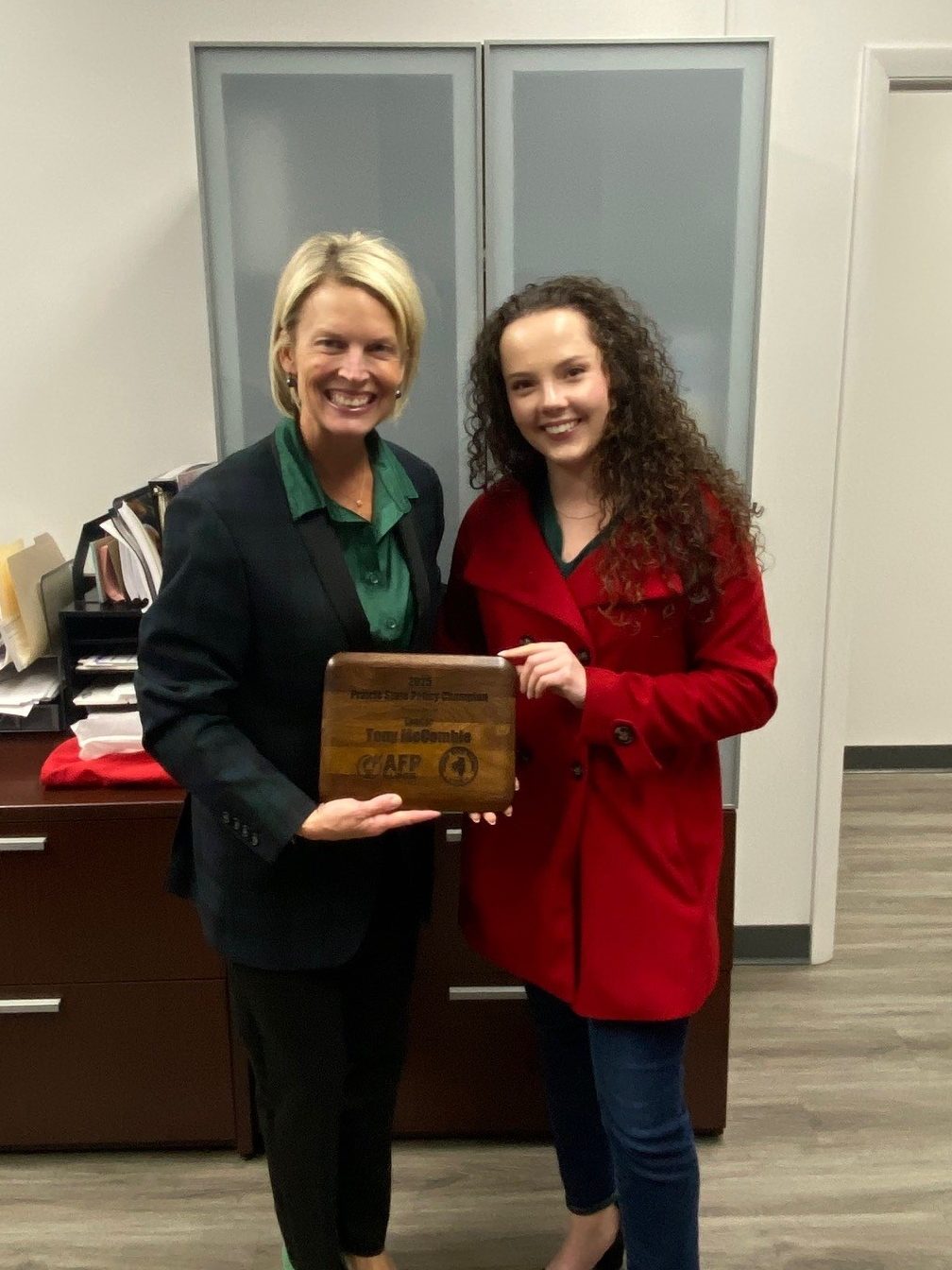
This news comes on top of some additional recognitions: I was recently named a Prairie State Policy Champion by Americans for Prosperity-Illinois (AFP-IL). The award was given to select lawmakers from across the state who have been leading advocates on reining in government spending, easing Illinois’ state tax burden, protecting homeschoolers and empowering educational choice in the Land of Lincoln. I’m proud of these recognitions, but even more proud of the work ahead. Illinois deserves leaders who stay focused, stay determined, and fight for opportunity, safety, and stability for every family.
HOLIDAY HEROES NEEDED
The Savanna Community Blood Drive will be held on Friday, December 19th from 10:00am to 2:00pm at the Savanna Fire Department Truck Bay, 101 Main Street, Savanna.
This holiday season, I’m inviting everyone to join us at our annual community blood drive and make twice the impact. Consider giving the gift of life by donating blood and the gift of hope by bringing a non-perishable food item for our local food pantry. Together, we can save lives, fill tables, and support families right here at home in NWIL.
The community blood drive has helped boost local blood supply every year, and I am hopeful this year’s event will continue to exceed expectations.
Along with donating blood, residents are encouraged to bring a non-perishable food item, which will help replenish local food pantry shelves following the Thanksgiving holiday.
Walk-ins are welcome but appointments are available. Residents can make an appointment online at redcrossblood.org or contact the Red Cross at 1-800-733-2767. To streamline your donation and save up to 15 minutes, you can visit RedCrossBlood.org/RapidPass to complete your pre-donation reading and questionnaire on the day of your appointment.